Why Always-On Watch Exists
A real April 2026 OpenClaw regression, a public founder reply, and the exact reason edge247 clients pay for ongoing stewardship instead of a one-time install.
By Dimitris Kontaxis ·
Why Always-On Watch Exists
Clients still ask a fair question: why should a business pay monthly for a deployed AI agent after the installation is already done?
The short answer is that the installation is not the end of the work. It is the start of production.
If the platform under the agent ships quickly, breaks an invariant, or changes how runtime dependencies are wired, somebody has to catch that before the client feels it on a Monday morning. That is what Always-On Watch is for.
April 2026 gave a clean example.
The issue was real, not theoretical
On April 24, 2026, we upgraded our own operator lanes to OpenClaw 2026.4.23.
That upgrade overwrote a local session-reset hotfix we were already carrying. The configuration was still correct, but the runtime behavior was not. For always-on agents running on WhatsApp and Discord, daily session reset could silently fail if updatedAt had been touched after the reset boundary while the active JSONL transcript had actually started the previous day.
In plain terms:
- the transcript could still be yesterday's
- the session store could look fresh
- heartbeat, cron, or system events could keep the old session alive
- the next real message would append to the wrong day
That is not a cosmetic bug. It changes production behavior for agents that run 24/7.
This is what the work actually looks like
When a release wipes a critical local fix, edge247 does not do three vague things like "monitor," "keep an eye on it," or "escalate internally."
We do concrete operator work:
- verify the regression on the live runtime we actually use
- compare runtime behavior against the promised reset invariant
- restore the local overlay so production behavior is preserved
- document the exact change in our maintenance records
- keep tracking upstream until a later stable release is proven equivalent
That is the part most clients never see, which is exactly why it is easy to underestimate.
The founder reply matters
After verifying the session-reset regression on 2026.4.23, I posted the exact production issue publicly to Peter Steinberger, founder of OpenClaw, including the business impact and the local patch shape we were carrying.
Here is the reply:
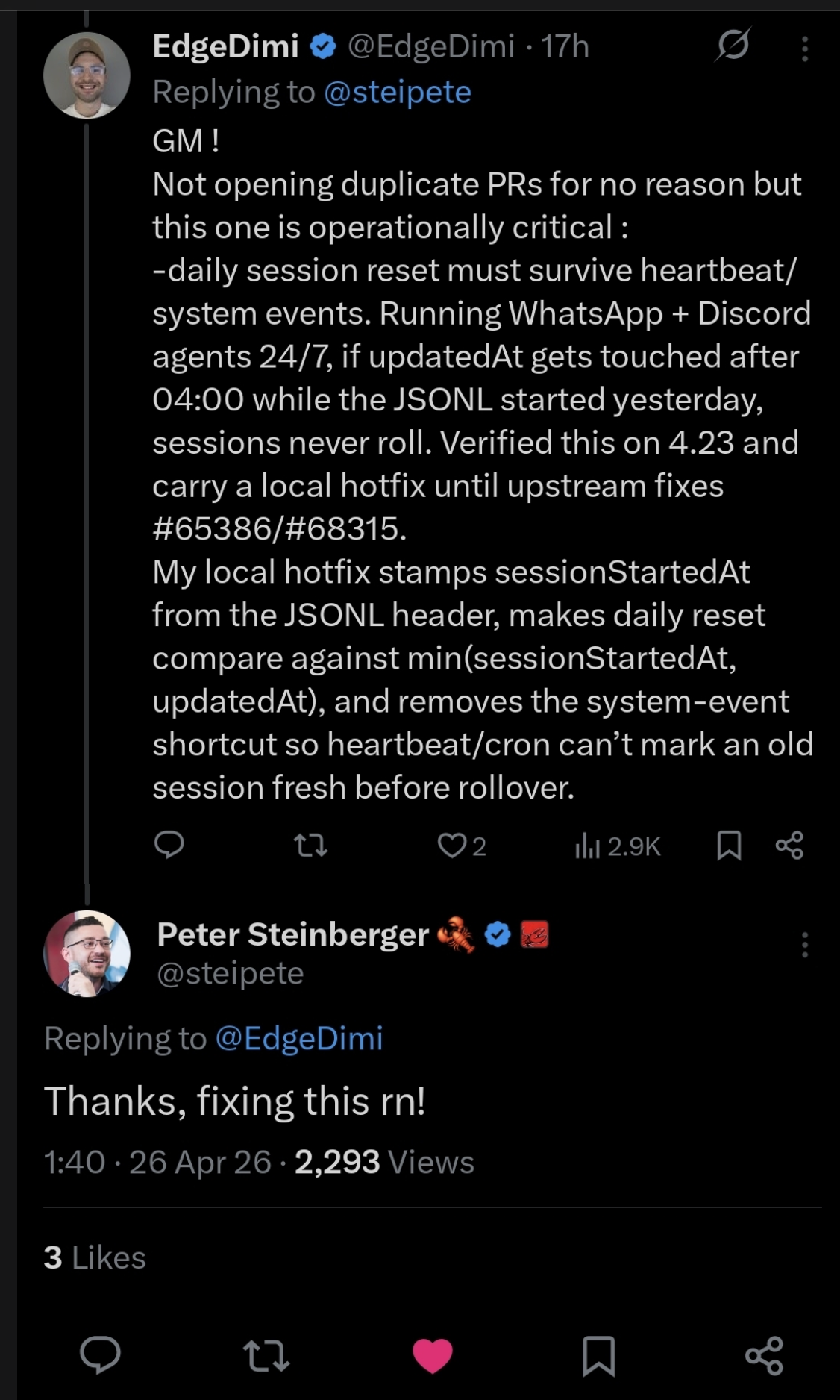
Public reply from Peter Steinberger on April 26, 2026. Original post:
x.com/steipete/status/2048185369099743390
The point is not vanity. The point is proof.
It shows that when a regression is operationally serious, the edge247 operator layer is not just reading release notes after the fact. We are close enough to the runtime to isolate the real failure mode, carry a safe local overlay, and hand upstream maintainers a maintainer-grade problem description.
Peter's public reply was short: "Thanks, fixing this rn!"
The important part came next: the upstream fix was merged on April 26, 2026 in PR #71845, fix: keep system events from extending session resets.
That PR added explicit session lifecycle timestamps and tightened reset behavior so heartbeat, cron, exec, and system bookkeeping would not keep stale sessions artificially fresh.
Why this still does not mean a client should just upgrade blind
This is the part businesses often miss.
An upstream fix landing on main is not the same thing as a client-safe stable release already containing it.
That was true immediately in this case.
OpenClaw 2026.4.24stable was published on April 25, 2026- PR
#71845merged on April 26, 2026 - therefore
2026.4.24stable did not contain the session-reset fix
So even after the founder had acknowledged the issue and merged the upstream fix, we still had to behave like operators:
- carry the local overlay on our current stable runtime
- reapply it after upgrade if the new stable release still lacked the fix
- verify the invariant ourselves before calling the lane healthy
That is not an edge case. That is normal production reality when a fast-moving upstream platform sits under a client system.
The next day proved the point again
On April 27, 2026, we upgraded the Core gateway to OpenClaw 2026.4.24 as a maintenance-capture release.
That run gave two different results at once:
- Memory got better. The old local memory provider wiring problem no longer needed the
manager-runtime.jspatch.node-llama-cpp@3.18.1still had to be resolvable from the active package root, but the previous memory code patch was no longer required. - Session reset still needed the overlay. Because
#71845merged after the2026.4.24stable tag, we still had to reapply the session-reset overlay on the Core runtime.
That is the best possible example of why Always-On Watch exists.
One release can remove one local patch and still require another one.
The work is not "upgrade or do not upgrade." The work is:
- know the active package root
- know which optional runtimes must resolve from it
- know which overlays are still live
- verify CLI and gateway behavior after restart
- block the parts that are still not safe
What a client is actually paying for
A client is not paying monthly for someone to click update.
A client is paying for a standing operator layer that can do five things reliably:
1. Release judgment
Every release gets a verdict against the exact architecture running on the client machine: upgrade, hold, skip, or promote later.
2. Runtime stewardship
If upstream moves optional dependencies out of the default install, we catch it and turn it into an explicit maintenance gate. That happened with local memory and node-llama-cpp.
3. Overlay inventory
If a production-critical fix is still local, we track it as a real maintenance artifact, not a forgotten hack on one machine.
4. Upstream leverage
When the issue is serious enough, we can surface it publicly, explain it clearly, and follow it through until an upstream fix exists.
5. Controlled promotion
Even after the fix exists upstream, we still decide when it is safe for a stable lane or a client lane.
That is the difference between an install and an operating service.
This is why edge247 does not sell "set it and forget it"
Open-source AI infrastructure is improving fast. That is exactly why it needs active stewardship.
The upside is real: every good upstream release can make an agent more reliable, more capable, or easier to maintain.
The cost is also real: releases can overwrite local overlays, change runtime contracts, alter dependency behavior, or break invariants that only show up on always-on deployments.
If you are the client, you should not be the person discovering that in production.
That is what Always-On Watch buys you: not passive monitoring, but a serious operator layer between your business and the release velocity of the platform underneath it.
The business takeaway
The value of edge247 is not that we can install OpenClaw on a Mac Mini.
The value is that we can keep a deployed Full-Time Agent healthy while the upstream platform keeps changing under it.
Sometimes that means holding a release.
Sometimes that means verifying a new optional runtime contract.
Sometimes that means carrying a local overlay for one more stable cycle.
And sometimes it means the founder of the upstream project replies in public, merges the fix, and we still do not declare victory until the right stable release lands and passes on our own hardware.
That is Always-On Watch.
Sources
- Peter Steinberger reply on X, April 26, 2026: x.com/steipete/status/2048185369099743390
- OpenClaw PR
#71845, merged April 26, 2026: github.com/openclaw/openclaw/pull/71845 - edge247 maintenance records for the
2026.4.23session-reset hotfix and the Core2026.4.24maintenance capture